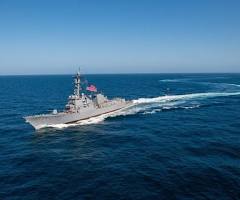
For years, the Arleigh Burke class guided missile destroyers (DDGs) have been the backbone of the Navy’s surface fleet
The U.S. Navy has 75 of these multi mission ships in service at the beginning of 2026. Although a destroyer by designation, the Arleigh Burke DDG is much more capable than the traditional post WW II destroyer. The DDG has anti-ship, anti-submarine, and anti-air weaponry added to its land missile capability, all on a high speed platform carrying state of the art electronics and combat systems.
- Displacement of 10,000 tons
- Powered by 4 GE turbines – 100,000 shaft horsepower; two shafts with five-bladed controllable-pitch propellers
- Speed in excess of 30 knots
- Range of 4,400 nautical miles
- 96 Vertical Launching System (VLS) cells with Tomahawk cruise missiles,3 types of Standard missiles and Sea Sparrow missiles
- Anti-submarine torpedo launching ASROCs
- One Mk 45 5-inch gun, Phalanx close in 20-mm guns, 25-mm Mk 38 and .50 caliber machine gun systems
- AEGIS electronics and combat system with AN/SPY-1 radars
In 2020 the Chinese People’s Liberation Army Navy (PLAN) launched Nanchang, their first Type 055 destroyer
NATO designates the Type 055 as the Renhai class cruiser. This is the best and most capable destroyer in the Chinese Navy. They refer to it as their “super destroyer.” As of early 2026, they have 8 vessels in service, with 8 more under construction. The Renhai class is considered to have at least the equivalent capability of the Arleigh Burke DDG. The Type 055 represents a significant step forward in China’s ability to conduct long-range, independent, or task-group operations.
- Displacement of 13,000 tons
- Powered by 4 QC-280 gas turbines – 150,000 shaft horsepower; two shafts with five-bladed controllable-pitch propellers
- Speed 30 knots
- Range of 5,000 nautical miles
- 112 Vertical Launching System (VLS) cells with YJ-18A anti-ship cruise missiles, YJ-21 anti-ship ballistic missiles, HQ-9B SAMs, and CJ-10 land-attack missiles
- Anti-submarine torpedo launching Yu-8s
- One H/PJ-38 130-mm gun, H/PJ-11 close in 30-mm gatling gun
- AESA electronics and combat system
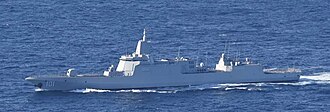
Some experts consider the Type 055 it to be more advanced and more heavily armed
However, the U.S. Navy relies on the sheer volume, networking, and combat-proven nature of the Arleigh Burke DDG to maintain superiority. The new DDGs under construction (Flight III) will have improved capabilities to close any suspected gaps.
By the next decade there should about 97 DDGs in service opposed to a possible 24 Type 055s. If the U.S. Navy had only half of the DDG fleet deployed around the South China Sea, it would still have 2:1 numerical superiority.
But the most significant advantage is the U.S. Navy’s decades of DDG operational and combat experience. The DDGs operate in large task groups and independently in all the oceans. A good example is the current Operation Epic Fury against Iran, where the DDGs protect task groups while striking hundreds of land targets.


